
INSURANCE · GUIDE
Motorhome insurance, sorted.
You want your van properly covered at a fair price but don't want to become an insurance expert to get it. Here's how motorhome, campervan and caravan insurance really works, where the cheapest quotes hide their catches, and our FREE downloadable pack that turns the dreaded ring-around into an hour's tidy work.

By Ged Wilmot. Facts checked .
In a nutshell...
The premium is the only number you see up front. The excesses, the valuation and the mileage limit decide what you actually get back.
Ask in any motorhome Facebook group and fifty people will name the firm that charges them £400. But prices depend on your van, postcode, storage, age and claims, so their cheapest can be your dearest. Ring round yourself.
A renewal is only one insurer's price. Ours came in at £686. One phone call, with a cheaper quote in hand, got it down to £595.
Get the free Ring-Around Pack: your answers on one page, a quote grid and three AI prompts that help you check the small print.
Email me the packOur directory lists 41 checked UK insurers and brokers, with the number to ring for each.
Open the directoryTow a caravan? Most of this applies to you too, but start with the caravan section, because it's a different kind of policy.
How much does motorhome insurance cost?
Most motorhome owners pay between about £400 and £600 a year. A touring caravan is far cheaper, at around £123. Those figures come from the two comparison sites that publish what their customers are quoted:
| What people pay | Where the figure comes from | |
|---|---|---|
| A typical motorhome | About £400 to £600 a year | Half of Compare the Market's customers were quoted under £406 (July to September 2026). Quotezone's average is £598. |
| The range most people fall in | £233 to £977 a year | Quotezone |
| By type of motorhome | Van conversion £395, coachbuilt £396, A-class £440 | Quotezone's typical price for each |
| A touring caravan | About £123 a year | Half of Compare the Market's customers were quoted under £123 |
Why such a wide range? Your price depends on the van's value, where it's kept, your age and claims history, and how much of Europe you want to see. Use these as a sense check.
Renewal well above these? Time to ring round. Our directory has 41 checked firms and the numbers to call.
Open the directoryThe three levels of cover
Third party only
- Damage or injury you cause to other people.
- Fire or theft of your van.
- Accident damage to your van.
The legal minimum for driving on UK roads.
Third party, fire and theft
- Damage or injury you cause to other people.
- Your van if it's stolen or catches fire.
- Accident damage to your van.
Comprehensive
- Damage or injury you cause to other people.
- Your van if it's stolen or catches fire.
- Accident damage to your van.
What if someone else hits you? Whatever level of cover you have, if another driver causes the accident, you claim for your van from their insurer. Where third party cover leaves you exposed is when the accident is your fault, or the other driver drives off or can't be traced. Comprehensive usually covers your van either way, and your insurer then chases the other side for the cost.
Hiring a motorhome? Our motorhome hire guide explains the insurance, deposit and excess checks before you book.
What does motorhome insurance cover?
Every policy is different, so check the wording carefully. But on a comprehensive motorhome policy, this is the usual picture.
Usually covered
- Accidental damage to your van, subject to the policy's conditions and exclusions.
- Other people: damage to their property and injuries you cause.
- Theft and attempted theft, as long as you've met the security and storage conditions.
- Fire, storm, flood and vandalism.
- Windscreen and glass, often with its own excess.
- Contents, up to a set limit per item and overall.
- Driving in Europe, for a set number of days a year.
Usually not covered
- Wear and tear, rust and old age.
- Breakdowns. A failed engine is a breakdown cover job, not an insurance claim.
- Keys left in the van, or leaving it unlocked.
- Damage from pets, insects or vermin.
- Neglect, such as damage from poor maintenance.
- Living in it full-time or hiring it out, unless your policy specifically covers it.
- A driver the policy doesn't name, or whose licence doesn't cover the van's weight.
Two things on that list catch out more owners than all the others put together: the security conditions and the storage rules. Both get a proper explanation in the ten questions insurers ask.
Extras: which are worth paying for?
- Legal expenses. Helps you recover money you lose after an accident that wasn't your fault, such as your excess. Useful, but check you don't already have legal cover on another policy.
- No-claims protection. Keeps your no-claims discount if you claim. It doesn't stop your premium going up, which is what most people assume it does.
- Personal accident cover. Often included already, and you may be covered by life or income protection insurance. Check before you pay for it twice.
- Breakdown cover. Worth having, but read the conditions carefully, because it may not cover you in the situations you'd expect. How breakdown cover differs from insurance.
Motorhome, campervan or caravan: what changes for each
They all end up on the same campsites, but insurers don't see them the same way. Here's what changes when you insure each one.
Motorhomes
Mostly simple: it's a motor vehicle, so cover works much like car insurance with a living area attached. Check that the body type on your V5C (log book) says what the insurer expects: usually "motor caravan". Then check that every driver's licence covers the weight, because that one catches more people than you'd think.
What licence do I need to drive a motorhome over 3,500kg?
- A standard car licence (category B) covers vehicles up to 3,500kg maximum authorised mass. The 4,250kg allowance you may have read about is for electric and hydrogen vehicles only. The government confirmed in March 2026 that it hasn't changed the rules for diesel or petrol motorhomes.
- Heavier than 3,500kg and you need category C1, which covers 3,500kg to 7,500kg.
- Passed your car test before 1 January 1997? You'll usually have C1 already, as a grandfather right. But it normally runs out at 70. You renew it by post, with a medical report from your doctor (form D4), not online like a car licence. Let it lapse and you're back to 3,500kg.
Don't take that grandfather right for granted, even before 70. Owners report C1 disappearing from their licence after a routine renewal. So before you buy anything over 3,500kg, turn your photocard over and find the C1 row. Dates next to it, and the second date hasn't passed? You've got it. Dashes? You haven't. You can also check free with the DVLA's View your driving licence service. If C1 is missing, contact the DVLA before you buy, not after, because driving a vehicle your licence doesn't cover can leave you uninsured.
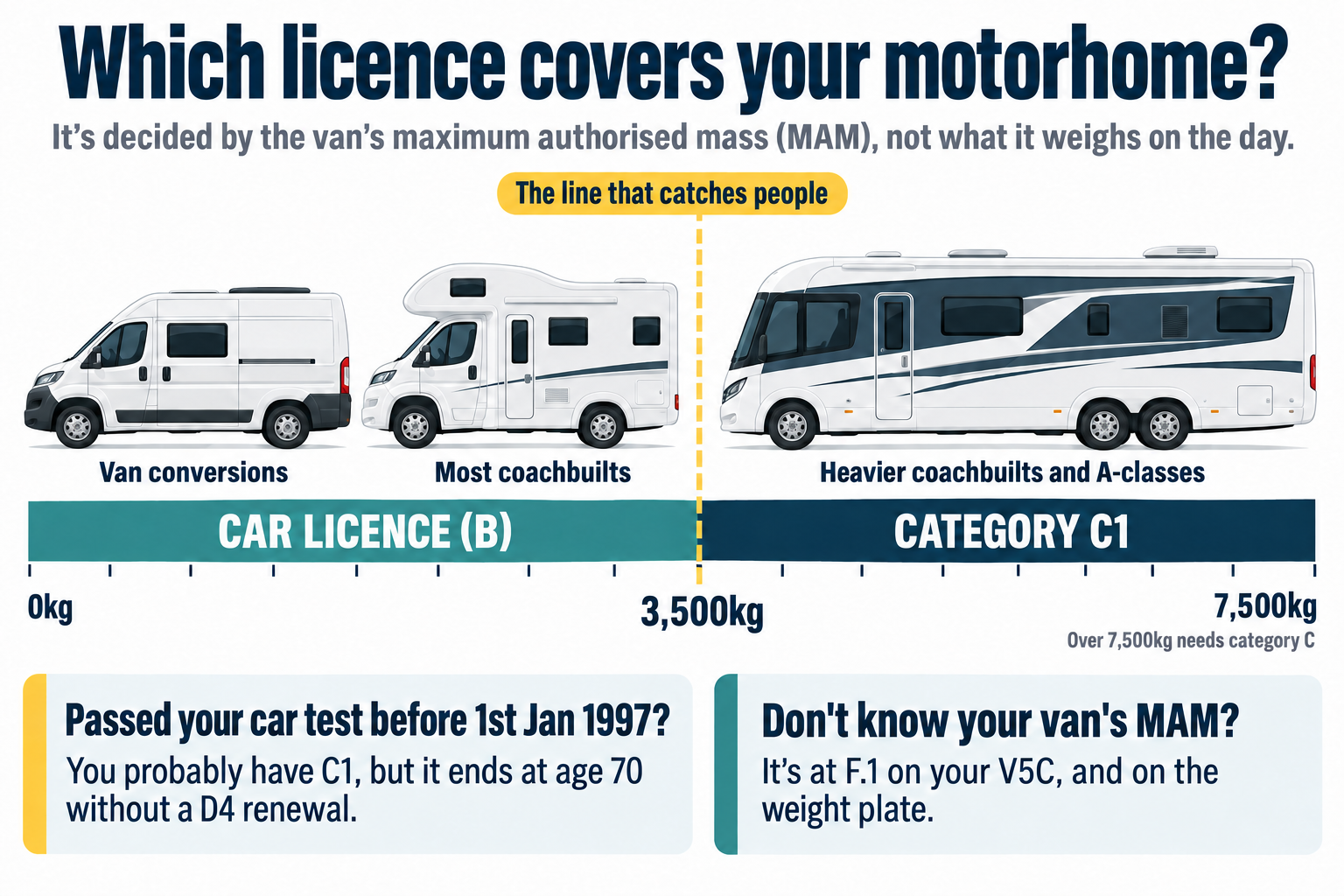

Official sources: driving licence categories and renewing at 70.
Campervans and conversions
The big question is who converted it, and can you prove it? Professional conversions, self-builds and vans still being built are different boxes with different prices, and some firms only handle self-builds on the phone. Keep your conversion invoices, photos and any gas or electrical certificates together. They're the difference between a smooth quote and a suspicious one. The directory shows which firms take self-builds.
Self-build? What the DVLA wants before it counts as a motor caravan
Many insurers want your V5C to say "motor caravan" before they'll insure a conversion as a campervan. To change the body type, the DVLA wants to see:
- Inside, all fixed in place: seats and a table, somewhere to sleep (it can be the seats), cooking facilities and storage.
- Outside, it has to look like a motor caravan in traffic. The features the DVLA commonly expects are two or more windows on one side of the living area, a separate door into the living area, motor caravan style graphics on both sides, an awning bar and a high-top roof. It judges the overall look rather than ticking off a fixed number.
You apply with photos of the inside and outside and the DVLA's conversion checklist. Full details are in the DVLA's guide to converting a vehicle into a motor caravan.
Touring caravans
This is the one that catches new owners out. Your car insurance typically covers damage you cause to other people while you're towing, but not damage to the caravan itself. Caravan insurance is a separate policy for the caravan, its contents and its equipment. It isn't a legal requirement, but going without means paying for any damage or theft yourself.
Expect security conditions too. Many policies name a device that must be fitted whenever the caravan is left unhitched, such as a wheel clamp or hitch lock, and cover depends on you actually using it.
Who you're actually buying from
When you buy motorhome insurance there are usually three layers, and the name you know is only the first. The brand takes your call. The broker behind it runs the quote. The insurer pays out.

There are plenty of broker companies in this market, which is why shopping around works. The catch is that you can't tell from the websites which brands belong together. We checked every brand in our directory against the FCA's public register, and eight groups of rival-looking names turned out to be one company each.
See which brands share an owner (8 groups, checked 29 September 2026)
| These brands… | …are the same company |
|---|---|
| Lancaster and Motorhome Protect | Insurance Factory Limited, part of the Markerstudy group |
| Safeguard and Scenic | Atlanta Insurance Intermediaries Limited, also part of the Markerstudy group |
| Devitt, Lifesure and the Caravan and Motorhome Club motorhome scheme | Arthur J. Gallagher Insurance Brokers Limited |
| Grove & Dean, Peter Best, Performance Direct and Motor-Vision | Grove & Dean Ltd |
| Howden, Shield Total and Club Care | A-Plan Holdings |
| Everywhen and Footman James | Advisory Insurance Brokers Limited |
| Sterling and Just Kampers Insurance | Herts Insurance Consultants Limited, a sister company of Adrian Flux |
| Caravan Guard and Leisuredays | Caravan Guard Limited, which also arranges and runs Swift's Supersure scheme |
If your "four quotes" came from two companies, you've done half the shopping you think you have.
Sister brands can quote differently, so by all means try one as an extra call. Just know what it's worth: they usually share the same insurers and claims team, so if one turns you down or loads the price, the other may well do the same. Spread your calls across different companies, not different shop fronts.
Why is one motorhome insurance quote so much cheaper?
Sooner or later the ring-around throws up a quote hundreds of pounds below the rest, along with a nagging feeling: "What am I missing?"
Sometimes nothing. A different insurer may simply like your van, age and postcode. But sometimes the gap is built from things you'd only spot in the documents. Here's an example with invented numbers, where every mechanism comes from real UK policy documents. Two quotes for the same £60,000 motorhome:
| Quote A: £420 a year | Quote B: £690 a year | |
|---|---|---|
| If it's stolen, you're paid | Market value, worked out after the theft | Agreed value: £60,000 |
| Total excess on a claim | £1,000 (£500 compulsory plus a £500 voluntary excess already ticked on the form) | £250 (£250 compulsory excess + £0 voluntary) |
| Mileage limit | 3,000, with an extra excess if you go over | 5,000 |
Now the van gets stolen. Quote A's insurer decides it was worth £51,000 on the day, because the second-hand market has dipped, and takes off £1,000 of excesses: you get £50,000. Quote B pays the £60,000 you agreed, minus £250: you get £59,750.

So when one quote is dramatically cheaper, don't bin it. Question it. Ask: "Your quote is well below the others. Can you talk me through the excesses, the valuation and anything that isn't included?" A good broker will answer happily. Either the gap survives, and you've found a real saving, or it doesn't, and you've just dodged Quote A.
Is agreed value worth it on a motorhome?
Ask what agreed value would cost, what it would pay out and what proof the insurer needs. Then compare that with market-value cover. With agreed value, the payout for a theft or write-off is fixed when you buy, so there's nothing to argue about later. With market value, the insurer decides what the van was worth after the event, which is exactly when you're least able to argue. Agreed value usually costs a little more, and the insurer may want photos or a valuation to back up your figure.
Five numbers to check before you pay
You don't need to read a policy like a lawyer. You just need these five, spread across the schedule, the IPID (the two-page summary) and the full policy wording:
- The valuation: market value, agreed value or new-for-old.
- Both excesses, compulsory and voluntary, which add together.
- Any special excesses, such as glass, theft or going over your mileage.
- The mileage limit, and what happens if you go over it.
- The storage condition: where the van must be kept, and how long it can be elsewhere.
The Ring-Around Pack's quote grid has a column for each of these five numbers.
Email me the packThe ten things that decide your motorhome insurance premium
Every insurer prices from roughly the same facts. Know your answers before anyone asks and the quotes come faster. More importantly, they're accurate, and an accurate answer is what any future claim stands on. The Ring-Around Pack has a page to write all ten answers down, so you give the same answers on every call.
Annual mileage.
An honest estimate, not a hopeful one. If you're unsure, round up.
Going over isn't a technicality. Comfort's Horizon policy, insured by Aviva, adds a £700 excess to any claim on the vehicle once you're 500 miles or more over your declared limit. Mileage usually has only a modest effect on a motorhome premium, so declaring 8,000 when you expect 6,000 tends to cost very little. If a big trip will take you over, ring the insurer before you go, not after the bump.
Where it lives overnight.
The address and postcode, and whether that's a driveway, the street, a locked compound or a storage site.
If you declare a storage site, your policy may only allow the van at home for 48 hours at a time.
It's one of the biggest price levers you have, and in some policies it's also a condition. Don't assume a secure compound is always cheaper to declare than your drive. Pricing leans heavily on postcode, and owners get surprised both ways, so get it quoted both ways.
How long can my motorhome stay at home if it's insured at a storage site?
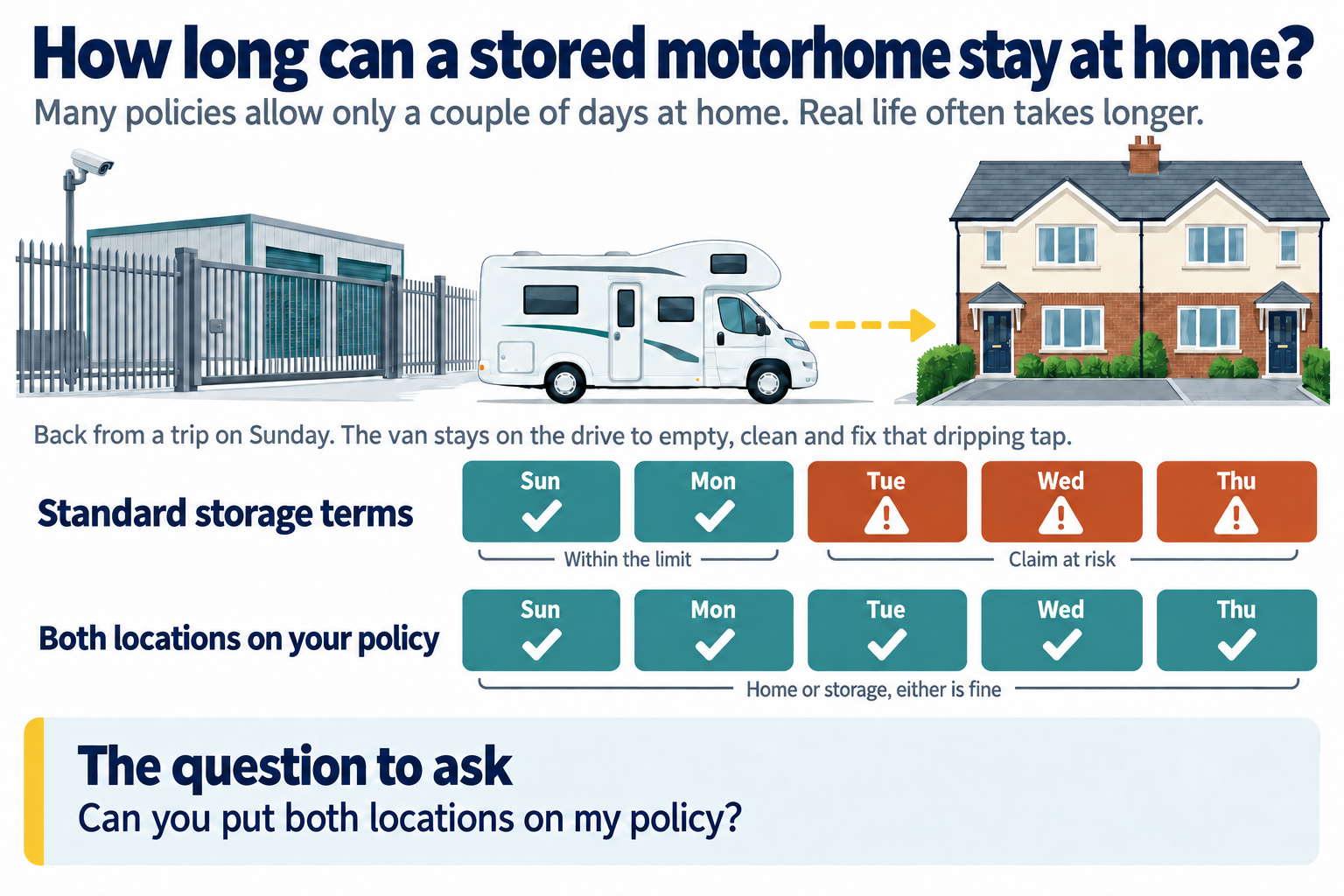
Less time than you'd guess, and it varies. Comfort's Horizon policy allows 48 hours at home for loading, unloading and cleaning. Leave it longer without telling them and the policy can be voided or a claim declined, and if a theft check finds the van isn't normally kept at the agreed storage place, the excess can rise to £500. Caravan Guard's current motorhome policy allows two nights at home for emptying, loading, cleaning or servicing.
A van declared at a secure site but stolen from your driveway is exactly the claim that gets argued. Whenever the arrangement changes, even for a while, ring the insurer and ask for a note on your file.
Security that's actually fitted and working.
Alarm, immobiliser, tracker (with a live subscription), wheel clamp, hitch lock. Declare what's real.
A device you declare can become a condition. If it isn't fitted when the van's stolen, the claim can be refused.
Caravan Guard's motorhome policy puts it in capitals: "FAILURE TO COMPLY WITH THESE SECURITY REQUIREMENTS MAY INVALIDATE YOUR POLICY AND ANY THEFT RELATED CLAIM." Wordings differ: some want the device on whenever the van's unattended, some only overnight, and some just use it to set the price. A tracker you've stopped paying for is worse than no tracker, because it breaks the very condition it was meant to meet.
Now picture real touring. You stop at a supermarket halfway through a trip. Are you fitting the wheel clamp for a forty-minute shop? Probably not. If your policy wants that clamp whenever the van's unattended, that car park is where what you declared and how you actually live part company.
Trackers are a special case. Many insurers insist on one once a van is worth around £50,000, and the type matters. Caravan Guard accepts a Thatcham S7 tracker on motorhomes worth up to £100,000 but wants an S5 (the kind with a driver tag) above that. An approved tracker can also bring a decent discount.
So tell the firm exactly which devices you have and how you really use them, then ask: "If I declare this device, when exactly does it have to be fitted?" Fewer declared devices can mean a slightly higher premium. That's the price of a policy that matches real life.
How we do it: we declare only the security that's always on the van (the factory alarm, immobiliser and tracker) and treat the clamp and pedal lock as extra deterrents rather than promises to the insurer.
The valuation you want.
Market value, agreed value or new-for-old. Decide before you ring.
Ask what evidence they want for an agreed figure, such as photos, a dealer valuation or the purchase invoice. Is agreed value worth it?
Who drives.
Every driver's details, licence, and anything the firm asks about points or medical conditions, answered exactly as asked.
Most motorhome policies cover named drivers only, so name everyone who'll drive.
What is the upper age limit for motorhome insurance?
It varies a lot. Footman James takes drivers aged 30 to 74. Caravan Guard takes new customers up to their 81st birthday and will usually renew existing customers up to 89. Safeguard takes new customers up to 79, says it may cover people into their 90s if you call, and has no upper age limit for renewals once you're with them. If you're heading towards 80, get settled with an insurer that will keep renewing you before you need to go looking.
How you use it.
Pleasure only, commuting, shows and festivals, lending it out, or hiring it out.
- Lending it to family or friends. "I didn't mention the odd weekend loan to my brother" is exactly the sort of gap claims fall through. Check who your policy lets drive. Short-term cover exists for a friend who wants to borrow it.
- Hiring it out. A normal private policy usually excludes hire. Camplify requires comprehensive insurance that covers hire, or cover through its own insurance partner. Goboony requires hire insurance and sells day-by-day cover for eligible vans.
- Towing a car on an A-frame. Some policies exclude towing any motorised vehicle, even though an A-frame car counts as a trailer on UK roads. Check before you hitch up.
Claims and incidents.
Everything in the exact period they ask about, including non-fault claims and windscreens if the question covers them.
Answer the question they ask, not the one you'd prefer.
The excesses you choose.
Your compulsory and voluntary excesses add together on the same claim.
Quote forms often pre-tick a voluntary excess to flatter the headline price. Untick it, let them quote clean, then decide. Watch for separate excesses too, most often on glass, and extra ones for young or inexperienced drivers. The two questions that cut through it: "If this van were stolen tomorrow, what's the total excess I'd pay?" and "Which claims carry a different excess?"
European travel.
How many days per trip and per year, and which countries.
- Days and level of cover. Cover abroad ranges from 30 days a year on some policies to 365 on others, and some drop to third party only once you leave the UK. Check both before you book the ferry.
- The 90-day rule. A year of European cover doesn't mean a year in Europe. On a UK passport you can spend up to 90 days in any 180 in the Schengen area, whatever your policy allows.
- Green cards. You don't need one in the EU or in several neighbours, including Switzerland and Norway. Check GOV.UK before going further afield.
- Paper copies. Pack printed copies of your insurance documents and V5C. You won't always have signal when someone asks to see them.
Anything that's changed.
Modifications, solar panels, a new tracker, a different winter storage place.
- Tell them. Policies expect you to keep them informed, and changes you sat on are claims they can question.
- Raise the value. A lithium battery, solar panels or anything else that would be sold with the van adds to what it's worth, so raise your insured value to match.
- Keep the invoice. It shows the work was fitted properly, by a qualified installer or to the maker's instructions if it's designed for DIY fitting.
Can I use my car's no-claims discount on motorhome insurance?
Sometimes, and the only way to find out is to ask. Some insurers will accept your car's no-claims years on a motorhome policy, even while you keep insuring the car. Others won't, and some don't use no-claims discounts on motorhomes at all. Where a firm won't transfer your discount, many will still mirror it: a matching discount without moving the years off your car policy. It's rarely advertised, so ask for it by name, and have your proof ready.
How can I get cheaper motorhome insurance? The ring-around method
Phoning for quotes has a bad name because most people do it unarmed. Done properly, it's an hour of your life once a year, and it's where the real savings are, because many specialist motorhome and caravan brokers aren't on the comparison sites at all.
10 honest ways to pay less
- Don't just let it auto-renew. A renewal is only one insurer's price. Why renewals jump
- Ring your insurer back with a cheaper quote. Ours dropped its price by £91 when we did.
- Get quotes three to four weeks before renewal. Why
- Ring specialist brokers, not just the comparison sites, and spread your calls across different companies. The directory has the numbers.
- Get prices for both your drive and a secure storage site. How storage affects you
- Ask whether an approved tracker brings a discount.
- If you belong to a camping or caravanning club, ask about member deals. Club Care, for one, offers Camping and Caravanning Club members a price promise.
- Ask for a multi-vehicle discount if you insure more than one vehicle.
- Ask to transfer or mirror your car's no-claims discount. How
- Pay annually if you can. Paying monthly usually means borrowing, with interest.
And one to be careful with: a higher voluntary excess cuts the premium, but only take one you could comfortably pay on the worst day of the year.
When to renew motorhome insurance for the biggest saving
When you get quotes changes what you pay. MoneySavingExpert's analysis of hundreds of thousands of car insurance quotes from MoneySuperMarket, covering February to April 2026, found cover was cheapest when bought 22 to 26 days before renewal: £374 on average at 25 days, against £708 on renewal day. Insurers' data suggests people who sort their insurance early are more careful drivers, so the same person gets pricier by the week as the date approaches.
The ring-around, step by step
- Pick four or five brands, mostly from different companies. The directory shows who shares an owner. Include at least one specialist for your type of vehicle, and a comparison site as a benchmark if you like. Then spend five minutes checking how each one handles claims.
- Prepare once. Write down your answers to the ten questions and keep them by the phone. The Ring-Around Pack has a page for exactly this.
- Write every quote into a grid: premium, the five numbers, European cover, storage rules, fees, the quote reference and the name of the person you spoke to. Allow 10 to 20 minutes a call.
- Before you hang up, ask them to read back the assumptions: vehicle, value, use, mileage, storage and drivers. A mistake caught now costs nothing. A mistake caught at claim time can cost you the claim.
- Get the documents before you pay: the schedule, the IPID and the policy wording, and check your five numbers. You normally have 14 days to cancel, but you can still be charged for the days you were covered plus an admin fee, so checking first beats cancelling later.
How do I check a motorhome insurer is good at paying claims?
Price is half the story. How a firm handles claims is the other half, and you only find out on the worst day of your touring year. Spend five minutes on each firm before you choose:
- Read the one-star reviews, not the average. On Trustpilot, filter to one star and search for "claim". A few angry reviews are normal for any big firm; the same complaint over and over isn't.
- Ask who actually handles the claim. With a broker, it may be the broker's own team or the insurer behind it. Ask "If I claim, who do I deal with?", then check their reviews too.
- Look at the official complaints figures. The Financial Ombudsman Service publishes complaints data for the firms it hears about most. A smaller firm may not appear at all, because the Ombudsman only publishes figures for firms above a minimum number of complaints. Not being listed doesn't tell you how good a firm is at claims.
- Ask other owners. Motorhome Facebook groups and forums are full of people who've claimed. Ask how the claim went, not how cheap the renewal was.
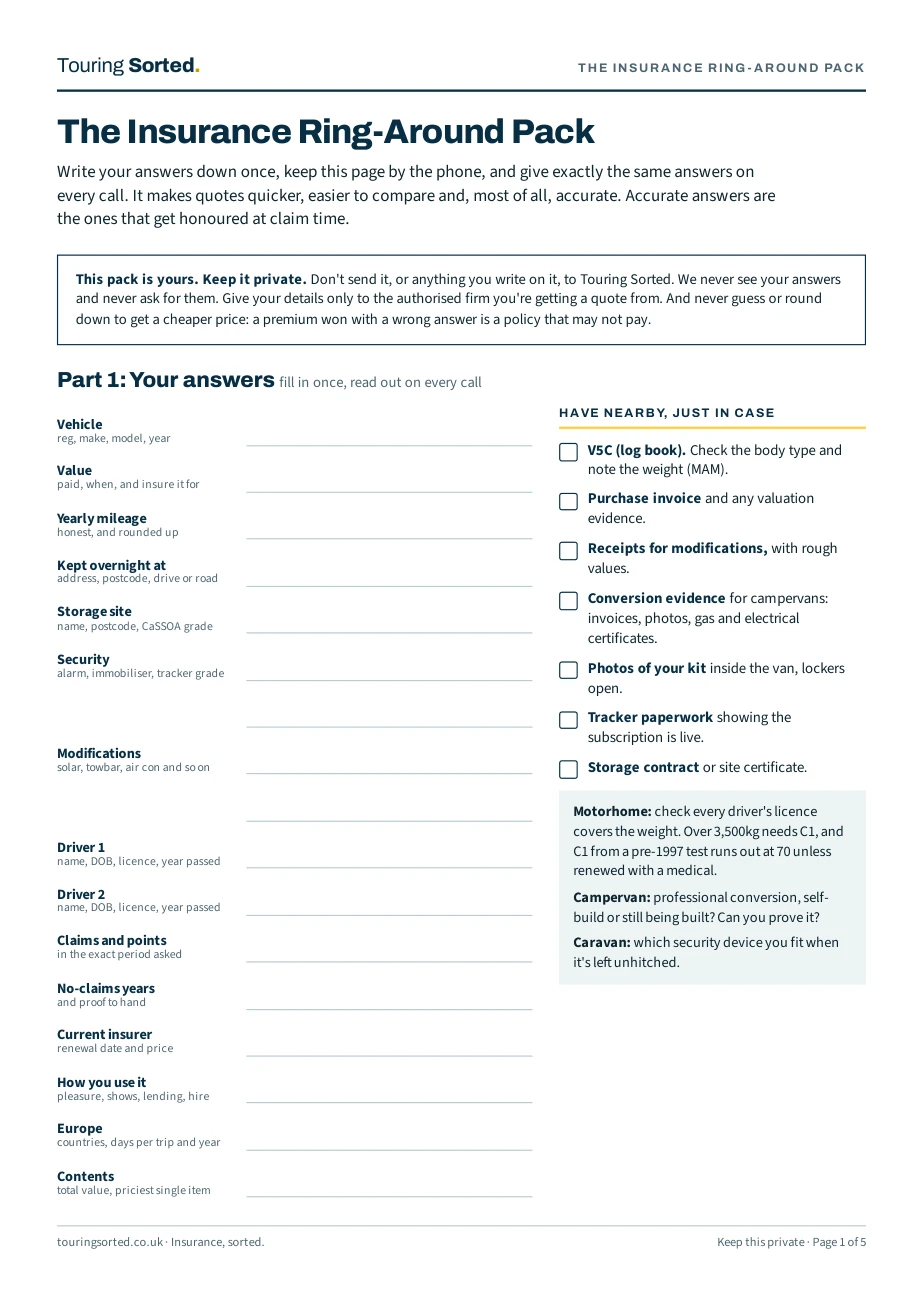
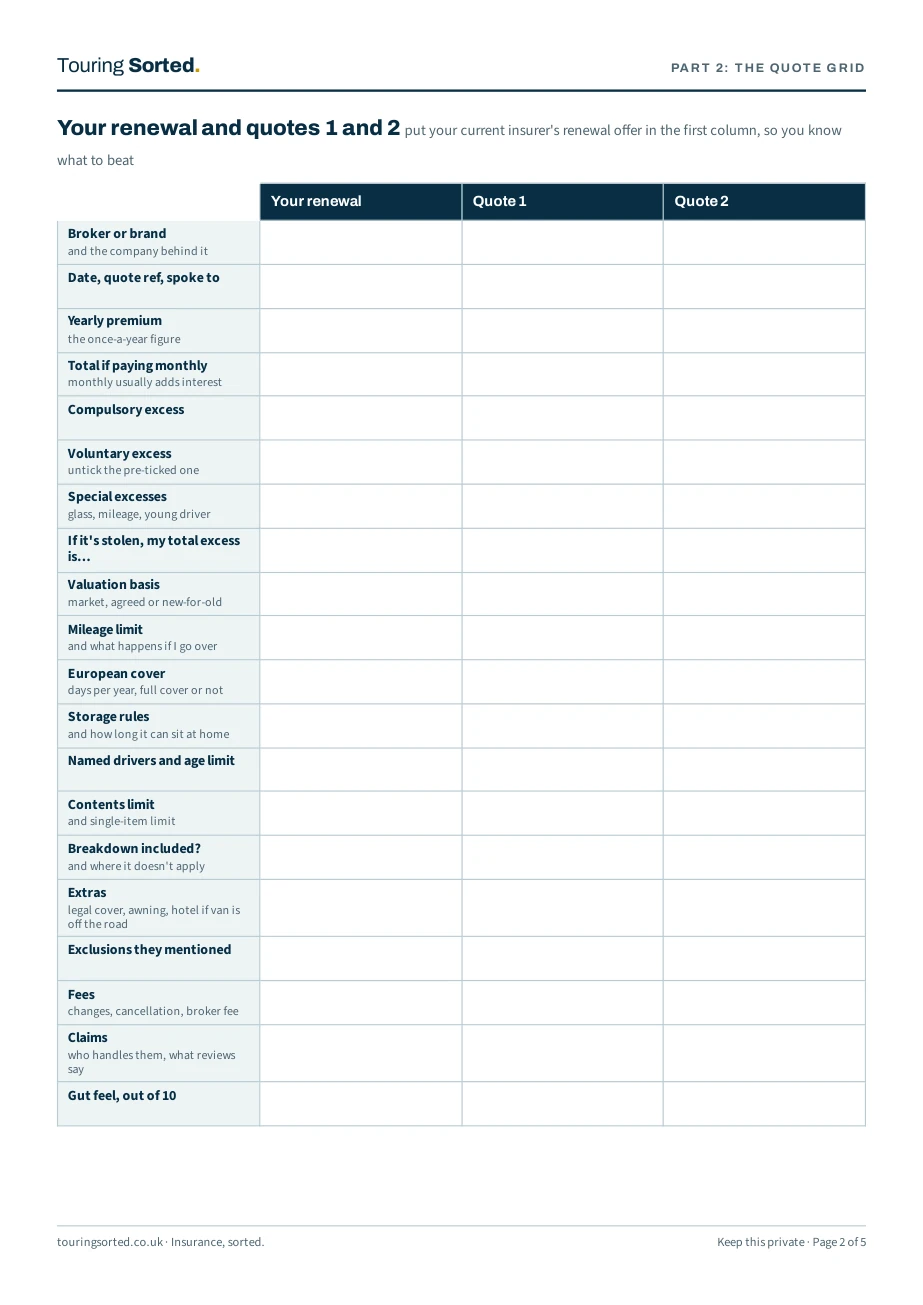
Doing the ring-around? Download the pack.
The Touring Sorted Ring-Around Pack puts your answers to everything insurers ask on one page, so you give the same answers on every call. It adds a quote grid that makes "cheap but worse" obvious at a glance, the questions to ask before you pay, and a checklist for after you buy. Print it and fill it in with a pen.
It comes with three AI prompts that help you check the small print. Paste one into ChatGPT or Claude with your documents and it explains, in plain English, what you're actually buying, with the page for every fact so you can check it.
If the form does not load, email us for the pack.
Can I use AI to check my motorhome insurance documents?
Yes, and it's the easiest way through a 40-page policy wording, as long as you ask the right way. Ask a vague question and you'll get a vague answer, delivered with total confidence. Our three prompts, which come with the pack, ask the AI to explain everything simply, name the page for every fact, and say when it isn't sure. Still check anything important with the insurer, because AI can still get things wrong. Blank out your personal details on the schedule before you upload it.
Motorhome insurance traps, and how to step round them
None of these are scams, and none are hidden. They're all in the documents, which is exactly why the documents are worth ten minutes of your time.
The thefts that don't count as theft
"Comprehensive" sounds like it covers everything. Theft is where that surprises people most. Leave the keys in the ignition while you pay for diesel and if the van's gone when you come out, most policies won't pay. If a burglar breaks into your locked house and takes the keys, that's theft, and it's usually covered. Check the policy's security conditions.
Keyless vans raise a newer question. Older policy wordings wanted signs of forced entry before they'd treat a loss as theft, and a keyless theft often leaves none. Selling the van brings another: many policies exclude theft by deception, so a "buyer" who drives off on a test drive and never comes back may leave you with nothing.
The contents you assumed were covered
Policies set an overall contents limit, a single-item limit, and exclusions for valuables, things left in an awning, or anything left in view. E-bikes are a particular flashpoint and often need separate cover once they're off the van. After a total loss, proving what was in the van, and what it was worth, lands on you at the worst possible moment.
Why has my motorhome insurance gone up at renewal?
Renewals that jump sharply, sometimes nearly doubling with no claims and no changes, are routine rather than rare. Theft claims on your model or in your area may have risen, the insurer behind your broker may have changed, or a firm may be quietly easing out of this market. Age plays a part too: car insurance figures show prices rising steeply from the mid-80s.
One protection is worth knowing. Since January 2022, FCA rules have stopped insurers charging you more to renew than they'd charge a new customer for the same cover through the same route, and the FCA has said that covers vans and touring caravans as well as cars. It doesn't stop prices rising for everyone, though, or a different firm being cheaper. Letting the policy roll over year after year is how a lot of owners end up paying far more than they need to.
Insurance, breakdown cover or warranty: three products, and the gaps between them
The most expensive mix-up in motorhoming is treating all of these as one thing called "being covered". They're three separate products, and the gaps between them are where holidays come unstuck.
Insurance
Covers sudden outside events: accident, fire, theft, storm, vandalism, plus your liability to other people.
Won't fix a breakdown. An engine that dies in a cloud of smoke without catching fire isn't an insurance claim.
Breakdown cover
Gets you moving again, or recovered, when the vehicle fails, and sometimes pays for onward travel and somewhere to stay.
Won't pay for the repair itself. Check who it covers, too: the AA, for example, says its breakdown cover isn't for vehicles over 3.5 tonnes or wider than 2.55 metres.
Warranty
Pays for qualifying mechanical and electrical failures, on its own terms.
Won't recover you, and usually gets narrower as the vehicle gets older.
The gaps bite hardest in Europe. Picture the engine failing abroad, a five-figure repair estimate and a garage that can't start for weeks. Nothing crashed or burned, so the insurance doesn't come into it, and everything hangs on your breakdown policy.
Before any European trip, check your breakdown cover:
- Will it bring a van of this size, weight and age home from Europe?
- What does it pay for while you're stranded?
- Who decides whether the van is repaired abroad or brought home?
- Do its European days match your insurance? 180 days of insurance with 90 days of breakdown cover leaves a gap exactly where you don't want one.
- Towing a caravan? Does it cover the caravan as well as the car?
If things go wrong
If you have to claim, make it easy for them to pay. Report a theft or malicious damage to the police straight away and keep the reference number. Have your V5C and policy details to hand, and make yourself available when the insurer's surveyor or engineer wants to see the van. Every delay on your side is a delay on the payout.
If it still goes wrong, two free, official backstops exist:
- The Financial Ombudsman Service settles disputes for free. Complain to the firm first, in writing. If eight weeks go by, or you get a final response you disagree with, you can take it to the Ombudsman, within six months of that final response. A well-documented complaint (dates, names, quote references and the Ring-Around Pack grid you filled in) tends to get sorted before it gets that far.
- The Financial Services Compensation Scheme (FSCS) steps in if an insurance firm goes bust owing you money. It pays 100% of a valid claim where the cover is compulsory, such as third-party motor cover, and 90% of other claims, such as damage to your own van. It's one more reason to buy from firms on the FCA Register, which is what the checks on our directory are for.
Motorhome insurance companies: 41 firms, checked
The full directory has its own page: 41 UK motorhome, campervan and caravan insurance companies and brokers, each checked against the FCA Register. For every brand you get the company behind it, what it really covers (including self-builds), the number to ring for a quote and a link to its Trustpilot reviews. It's alphabetical, and nobody has paid to be on it.
BEFORE YOU RING ANYONE
Get the Ring-Around Pack
Your answers on one page, a quote grid that shows up the cheap-but-worse trick, and three AI prompts that help you check the small print. Free, straight to your inbox.
Email me the packQuick questions
Is motorhome insurance a legal requirement?
Yes. A motorhome must be insured even if it only sits on your drive, and you need at least third party cover to drive it. The one exception is a van declared off the road (SORN).
Do I need insurance if my motorhome is SORN?
Not legally. A vehicle declared off the road doesn't need motor insurance. But it can still be stolen, flooded or damaged, so most owners keep fire and theft cover, often called laid-up cover, and many storage sites insist on it.
Can I insure a motorhome I live in full-time?
Yes, but not with everyone. Comfort offers full-timer cover case by case, and needs a UK address for the van and your licence. Sterling offers "van life" cover if you have a mailing address. Caravan Guard and Footman James don't cover full-time living.
The jargon, if you want it
You've probably insured cars for decades, so most of this will be familiar.
Show the jargon buster (13 terms)
| The word | What it actually means |
|---|---|
| Insurer | The company that takes on the risk and pays claims. Think of it as the airline. |
| Broker | The company that sells you the policy and deals with you. Think of it as the travel agent. Most of the motorhome "insurance companies" you've heard of are brokers. |
| Underwriter | Another word for the insurer, or the person there who prices your risk. If a broker "uses a panel", several insurers sit behind it, and your renewal can quietly move from one to another. |
| Premium | What you pay. Check whether a quote is the yearly figure or a monthly instalment, because paying monthly usually means borrowing, with interest. |
| Excess | The first slice of any claim, which you pay yourself. The compulsory excess is set by the insurer. A voluntary excess is extra you agree to take on for a cheaper premium. The two add together. |
| IPID | Insurance Product Information Document. A standard two-page summary every policy has to have. It's the menu. The policy wording is the meal, and that's what counts. |
| Schedule | The page listing your details: vehicle, sums insured, excesses and any special conditions. Spotting mistakes on it is your job. |
| Market value | What your van would sell for second-hand on the day you claim, worked out by the insurer after the van's stolen or written off. |
| Agreed value | A figure you and the insurer write into the policy when you buy it, so the payout is settled in advance. |
| Levels of cover | Third party only, third party fire and theft, and comprehensive. See the three levels of cover near the top. "Comprehensive" doesn't mean everything: wear and tear and breakdowns aren't covered. |
| NCD | No-claims discount. Ask whether yours can be transferred in, mirrored from your car, or protected. Every firm treats it differently. |
| Endorsement | A bolt-on clause that changes the standard wording. Often it's a condition you have to meet, such as a tracker being active. Break it and the related cover can fall away. |
| SDP | Social, domestic and pleasure: the everyday use most motorhome policies cover. Commuting and business use are extras you have to ask for. |
Who checked this page
What's changed on this page: 16 November 2026: rechecked every figure. Updated the Compare the Market costs and Caravan Guard's age limit, and noted that four of the brands share a group. 29 September 2026: reorganised to be quicker to use. Added what's covered and what isn't, the three levels of cover, extras, ways to pay less and the DVLA self-build rules.
Sources
Sources, checked 16 November 2026:
- The FCA Register and each firm's own website and terms of business, for every directory entry.
- Comfort Insurance Horizon motorhome and campervan policy wording, insured by Aviva (document ref SMOMG2381 11.2025), for the mileage excess, storage and reasonable-care examples.
- Caravan Guard motorhome policy booklet (dated 09/09/26), for the security wording and the two-nights-at-home rule.
- Caravan and Motorhome Club: Caravan Cover, for the discretionary arrangement, lending add-on and unhitched security rules.
- MoneySavingExpert: when to renew car insurance, for the timing data.
- FCA policy statement PS21/5, for the renewal pricing rules.
- GOV.UK driving licence categories, renewing at 70 and View your driving licence, for the licence rules.
- Honest John: the DVLA have removed C1 from my licence, for C1 going missing at renewal.
- DVLA: converting a vehicle into a motor caravan (updated 7 August 2020), for the self-build rules.
- AA caravan and motorhome breakdown cover, for the size limits.
- Compare the Market motorhome insurance, caravan insurance and Quotezone motorhome insurance, for the cost figures, and Compare the Market for the usual covered and not covered items.
- Which?: the car insurance add-ons worth paying for and MoneyHelper: should I protect my no-claims bonus?, for the extras.
- Footman James, Adrian Flux, Caravan Guard and Safeguard, for age limits.
- Caravan Guard tracking devices, for tracker requirements.
- Comfort Insurance policy comparison, Lancaster and Alan Boswell, for European cover.
- Comfort, Sterling van life insurance and Caravan Guard, for full-timers.
- Club Care, for the Camping and Caravanning Club price promise.
- Camplify owner rules and Goboony hire insurance, for renting your van out.
- GOV.UK: uninsured vehicles, for SORN and the legal requirement.
- GOV.UK: vehicle insurance when driving abroad and how long you can stay in the EU without a visa, for green cards and the 90-day rule.
- Mel Savage, Head of Insurance Product at Ripe, interviewed by Motorhome Matt (21 September 2026), for keys left in the vehicle, keyless theft, theft by deception, towing a car, upgrades and claims paperwork.
- Financial Ombudsman Service and FSCS insurance protection.
Spotted something wrong or out of date? Tell us and we'll fix it. That's the deal.
Disclaimer
Touring Sorted isn't an insurance adviser, broker or comparison service, and isn't authorised by the FCA. Nothing here is advice or a recommendation of any policy for you. It's general information to help you ask better questions of the authorised firms that can advise you. Policy examples quote specific, named documents on the date shown and won't match every policy. Our insurance pages have no paid links, and no firm can pay to appear in the insurance directory. We never accept free kit in exchange for a review, and we don't publish sponsored posts. See how Touring Sorted makes money and how we check our information.